
IGBC Launches Five New Green Ratings, and Health and Wellbeing Now Sits at the Centre of Office Design
India’s green building council has put health and wellbeing at the centre of its next round of ratings. The Confederation of Indian Industry’s Indian Green Building Council, known as CII-IGBC, launched five pilot rating systems on the first day of the Green Building Congress 2026 in Mumbai, and one of them is a Health and Well-being Rating System. For companies planning an office in Delhi NCR, that matters more than it first looks. A rating that judges how a workplace treats the people inside it will shape what landlords build and what tenants ask for in a fit-out.
The Congress is the 24th edition of India’s flagship event on green buildings and the built environment. It ran from 26 to 28 November 2026 at the Jio World Convention Centre in Mumbai, under the theme Forging a Sustainable Future. IGBC marked 25 years of its green building movement at the event. Its footprint now stands at more than 16.55 billion sq ft across over 20,620 registered projects, with Maharashtra contributing about 5.01 billion sq ft. B Thiagarajan, immediate past national chairman of CII-IGBC, set out three milestones for the movement: mainstream green buildings by 2030, scale net zero buildings and sustainable communities by 2035, and contribute to India’s national net zero commitment by 2070.
What the five new ratings cover
The five pilot systems launched at the inaugural session are the Green Retail Rating System, the DigiBuild Rating System, the Health and Well-being Rating System, the Green Healthcare Facilities Rating System and the Green Service Building Rating System. IGBC launched them to extend sustainable building practices across more types of buildings, covering retail spaces, digital infrastructure, workplaces, hospitals and service establishments.
Two of the five speak directly to offices. The Health and Well-being Rating System treats the indoor environment as something to be planned and measured, not left to chance. The Green Service Building Rating System covers the service buildings that keep offices running. DigiBuild covers digital infrastructure, which in an office means the cabling, connectivity and building systems that a fit-out has to live with for years. The other two, retail and healthcare, matter less to an office tenant, but they show the same direction of travel. Sustainability is moving from the shell of the building into how each type of space is actually used.
IGBC also signed two agreements at the inaugural session. One, with Bhutan’s National Housing Development Corporation, covers technical guidance and training for green buildings in Bhutan. The other, with the Consortium of Accredited Healthcare Organisations, promotes the Green Healthcare Facilities Rating System. Neither agreement changes an office fit-out in Noida or Delhi directly. Both show that IGBC is building partnerships around its ratings rather than launching them alone.
Delhi NCR already leases green, so the bar is already high
The new ratings land in a market where green is already the norm for new office deals. Colliers India reported on 5 November 2026 that leasing in green-certified assets is projected to reach 60 to 65 million sq ft across India’s top seven office markets in 2026, which would be over 80 percent of all office leasing. In Delhi NCR, green assets accounted for 85 to 90 percent of office leasing over the last three to four years, the highest share of any of the seven markets, with 38 million sq ft of the region’s 44 million sq ft leased in green assets in that period.
The stock figures point the same way. Nearly 70 percent of Grade A office stock across the top seven cities is expected to be green certified by the end of 2026, about 636 million sq ft, and Colliers expects green stock to reach close to 800 million sq ft in the next two to three years, with green assets forming nearly three quarters of India’s office inventory by 2030. Bengaluru and Delhi NCR together hold nearly half of the current green assets. For a company taking space in Delhi NCR, a green building is therefore not a premium choice to hunt for. It is the default on offer, and the questions worth asking have moved on from whether a building is certified to what the certification actually covers inside the floor.
That shift is where the new Health and Well-being Rating System earns its place. A building can be energy efficient and still be a poor place to work for eight hours a day if the air is stale, the light is flat and the noise never drops. A rating that looks at health and wellbeing separately gives tenants a way to ask about those things in the same language as energy and water, instead of treating them as soft extras that get cut when the budget tightens. Our office interior design services in Delhi already hear this in briefs, with daylight, quiet rooms and air quality raised at the start of a project rather than at handover.
What changes inside the fit-out
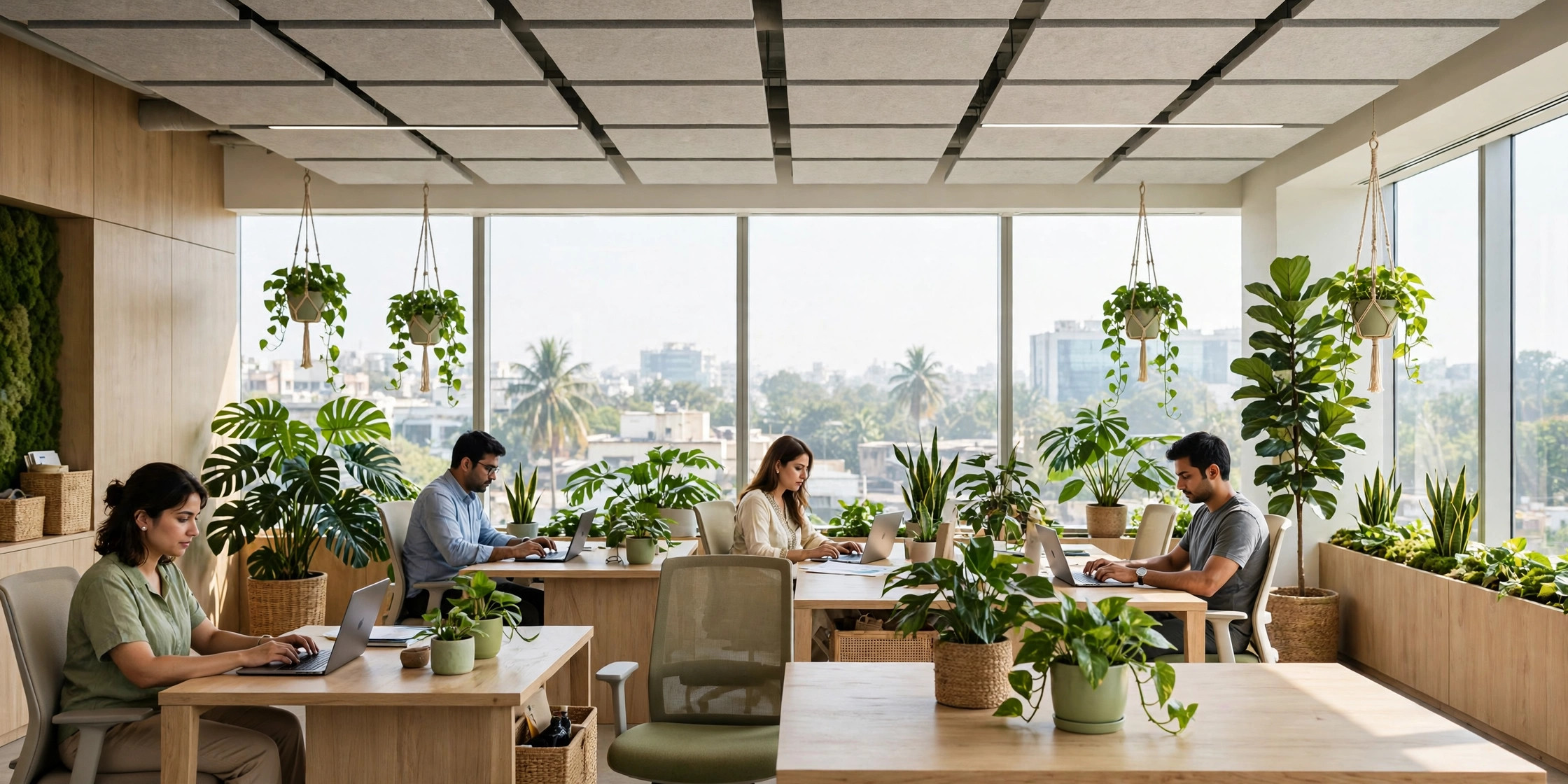
The practical effect of the new ratings will show up in fit-out decisions, not in press releases. If health and wellbeing is going to be rated, the items that support it need to be in the design and in the BOQ from the beginning. Daylight and glare control, fresh air and filtration, acoustic treatment in open areas and focus rooms, lighting that suits the work being done, and planting that is real and maintained all become part of the rated outcome rather than decoration added at the end. None of this needs exotic material. It needs decisions taken early, while partitions, ceilings and services can still be moved without rework.
DigiBuild points the same way for the technical side of a fit-out. An office that depends on video calls, shared screens and cloud tools cannot treat connectivity as an afterthought. Cable routes, power points, Wi-Fi coverage and room booking systems have to be planned with the layout, not fitted around it. When a rating system starts to cover digital infrastructure, the cost of getting it wrong also becomes visible, because a floor that looks finished but drops calls in every meeting room will fail the people using it even if it passes a visual check.
The retrofit angle matters just as much for NCR. Colliers notes that more than 450 million sq ft of India’s existing office stock is over a decade old and may need significant upgrades, and that most redeveloped assets are expected to obtain green certifications. A company refreshing an older floor in Noida or Ghaziabad does not need to wait for a new tower. A refit that improves air, light, acoustics and energy use can bring an older building closer to what tenants now expect, and the new ratings give that work a clearer standard to aim at. Talk to our office interior designers in Noida about refreshing an older floor around health, light and quiet, instead of only repainting it.
What to check before your next fit-out
Three checks help before a layout or a lease is signed. First, ask what the building’s certification actually covers, and whether health and wellbeing is part of it or only energy and water. A certificate on the lobby wall does not by itself guarantee good air or quiet rooms on your floor. Second, put the wellbeing items in the first version of the BOQ, with daylight, acoustics and air given the same standing as desks and partitions, so they are not the first things removed in a value exercise. Third, plan the digital layer with the layout, with cable routes, power and meeting room technology decided before partitions go up, so the floor works on the first day of occupation rather than after a round of fixes.
Green ratings will keep expanding, and the next milestone IGBC has set is mainstream green buildings by 2030. Companies that plan their offices around the people inside them, with light, air, quiet and reliable technology built in from the start, will not need to chase each new rating as it arrives. Their floors will already meet it. A turnkey office interior planned as one job keeps design, build and furniture in a single plan, so the health and wellbeing of the floor is decided before work starts, not discovered after handover.
Sources: Construction Week India report; RealtyNMore report; Colliers India press release.