
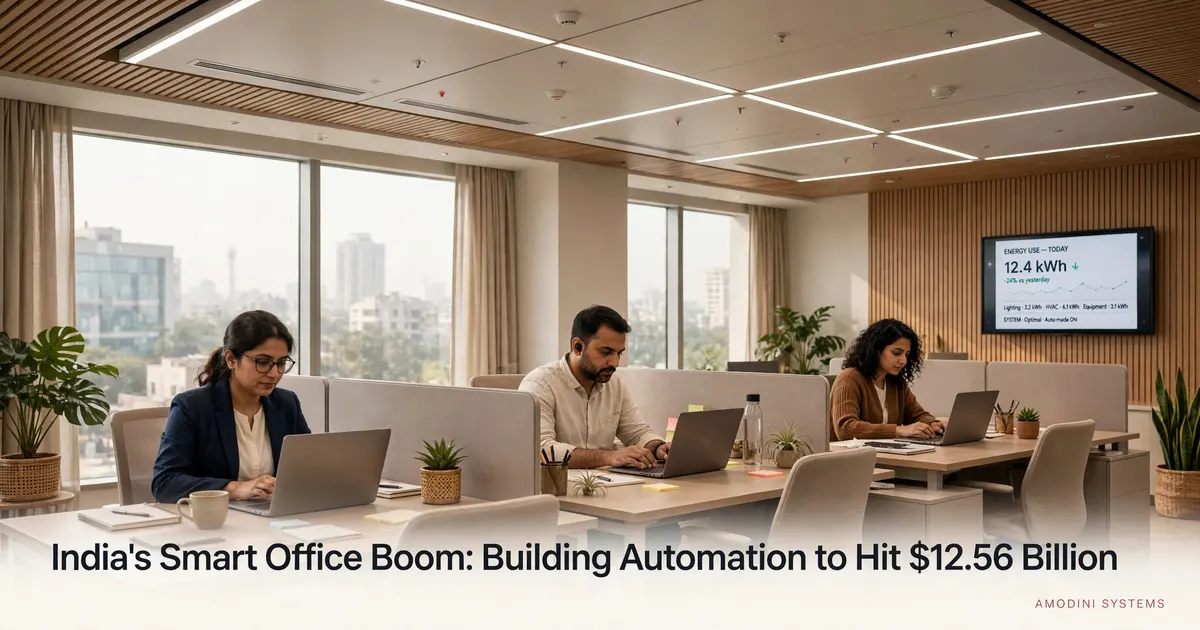
India’s Smart Office Boom: Building Automation to Hit $12.56 Billion
Written by Raj Gupta | Reviewed by Satyam Maurya
Artificial intelligence is moving into the walls of Indian offices. Sensors track how rooms are used, software adjusts cooling floor by floor, and maintenance issues get flagged before they break anything. MarketsandMarkets projects India’s building automation market will grow from 4.32 billion dollars in 2025 to 12.56 billion dollars by 2030, a compound annual growth rate of 23.8 per cent. The figures were discussed at ORGATEC India 2026 in Mumbai this week, and they change what a company should ask for in its next office fit-out.
The numbers
A CII and Cushman and Wakefield report projects that IoT enabled automation across organised commercial office space will rise from 25 per cent to 45 per cent by FY2030, while integrated building automation and management systems will rise from 8 per cent to 23 per cent. Digital optimisation can cut building energy use by 5 to 40 per cent, according to the International Energy Agency, which is why owners are paying attention.
The retrofit opportunity
The bigger story is old buildings, not new ones. India has around 420 million sq ft of ageing office stock, and Colliers puts the retrofitting opportunity at more than 50,000 crore rupees. That matters for Delhi NCR, where much of the office stock was built before smart systems existed. A ten year old floor in Gurugram or Noida can gain sensors, smart lighting and air quality monitoring without being rebuilt, but only if the fit-out leaves room for it. Wireless sensors have made retrofits cheaper, and the payback comes from energy savings and better use of space.
Our office interior designers in Noida retrofit sensors, smart lighting and air quality monitoring into an existing floor without rebuilding it.
What it means for companies in NCR
Workplace design cycles have shortened from 10 to 15 years to 3 to 5 years, according to Bajaj Finserv’s Taanmaay Ashok Khare, speaking at ORGATEC India. A fit-out planned today will be judged, and probably redone, within five years. Prime office rents in Delhi NCR rose 5.4 per cent in the September quarter, and the region now ranks as the seventh costliest prime market in Asia Pacific, according to Knight Frank. Paying more rent for a floor that cannot tell you which desks sit empty is a hard cost to defend. Global capability centres are also spreading into emerging hubs such as Jaipur, so the smart office brief is reaching mid sized companies, not just multinationals. Companies planning an office in Delhi NCR should treat technology as part of the fit-out decision from day one.
Our office interior designers in Delhi plan technology into the fit-out from day one, so sensors, cabling and ceiling space are in the design before work starts.
What to plan in your next fit-out
Four checks help before any system is bought. First, decide what the office must do, then pick the system. Energy saving, attendance tracking and air quality are three different jobs, and one dashboard rarely does all three well. Second, plan cabling and ceiling space for sensors at the design stage. Adding them after the ceiling is closed costs far more. Third, ask for open systems that work with more than one vendor, so a single supplier cannot lock the building into its own platform. Fourth, keep the human part in view. Acoustics and visual comfort are essential now, not extras, and a smart office that is noisy or badly lit has failed at its first job. A fit-out that covers these four points will still be useful when the next wave of technology arrives.
Smart buildings are not about gadgets on the wall. They are about an office that knows how it is used and adjusts itself, and the market says that office is becoming the standard. Talk to our team about a turnkey office interior where layout, furniture and technology are planned together, or speak to our office interior designers in Noida about making an existing floor smarter.