
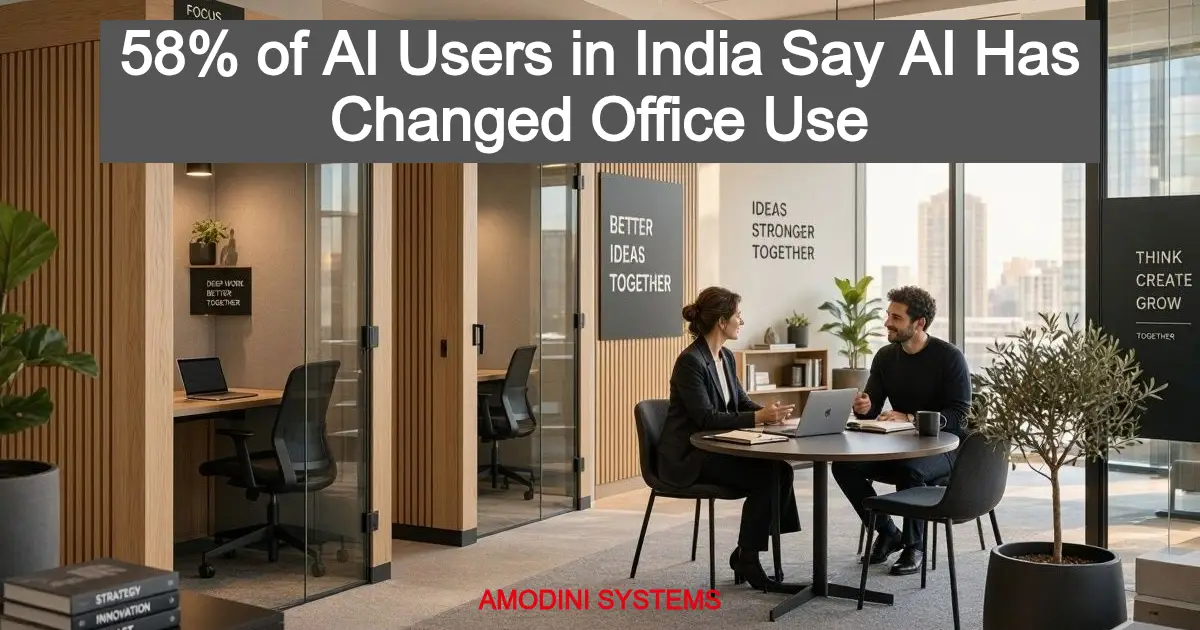
58% of AI Users in India Say AI Has Changed Office Use
Written by Raj Gupta | Reviewed by Satyam Maurya
Artificial intelligence has changed how office work happens in India faster than it has changed the offices themselves. A new Steelcase survey of 5,438 office workers in nine countries finds that in India, 58 per cent of AI users say AI has already changed how they use their office, against 47 per cent across Asia Pacific and 35 per cent globally. The survey was fielded between 2 December 2025 and 13 January 2026, and included 593 respondents in India. For a Delhi NCR company planning an office, the message is plain: the work has moved on, and the floor plan must catch up.
The privacy gap
The clearest gap is privacy. Across Asia Pacific, 43 per cent of employees most commonly take video calls at their desks, although 87 per cent would prefer to take them somewhere else, and 61 per cent say they cannot find privacy when they need it. Amber Matthews, Global Director of WorkSpace Futures Research at Steelcase, says a desk video call reveals a bigger gap between how people work today and the spaces available to them: noise, overheard conversations and broken focus. These are Asia Pacific figures, not India only figures, but any open Noida or Gurgaon floor with no call space will recognise the picture.
India is different: more interaction, not less
India does not fit the story that AI makes office work lonely. In India, 83 per cent of AI users say AI has increased their interactions with colleagues. That means more short conversations, quick video calls and small group work, all in the same floor at once. A desk-only office will feel noisy, and a meeting-only office leaves no quiet place to think. The floor must hold both.
Choice of space, not more desks
The survey points to one fix: choice. When employees can choose from three or more types of space, from quiet rooms to places to meet, take calls or recharge, they report higher wellbeing, engagement, productivity and sense of community. In Asia Pacific the reported gains were 20 per cent for wellbeing, 17 per cent for engagement, 14 per cent for productivity and 21 per cent for sense of community, each above the global average. These are self reported differences linked with choice of spaces, not proof that one pod raises productivity by 14 per cent. Still, teams work best moving between a quiet corner, a call booth and a table for four, without booking a room for every small task.
What it means for your next fit-out
Our office interior designers in Delhi hear the same complaint every month: the office looks good in photos, but nobody can take a call without whispering. Four checks help before a layout is signed. First, count the calls at peak hour. That count is the number of call booths the plan must hold. Second, separate noise from quiet with distance and acoustics, not only glass, which leaks sound without acoustic treatment. Third, plan three zones in every floor: focus, calls and collaboration. Fourth, leave room to change, with modular furniture and movable screens. Talk to our team about a turnkey office interior planned as one job, or speak to our office interior designers in Noida about fixing the privacy gap in an existing floor.
AI will keep changing how work is done. The offices that keep up will give people a choice of where to do each kind of work, in the same floor, on the same day. That choice is cheapest to make before the fit-out starts.
Sources
- Steelcase, 16 November 2026: AI is Changing the Office Faster in Asia Pacific than in the Rest of the World
- ET HRWorld (PTI), 16 November 2026: AI Revolutionizes Workspaces in Asia Pacific: A Survey Reveals Insights