NCR Has 81 Million Sq Ft Ready to Retrofit: Knight Frank
A good office location does not go out of date as fast as the building standing on it. Knight Frank India says a large part of India’s older office stock is worth upgrading rather than leaving behind. Its report, Age to Advantage: Retrofitting India’s Office Stock, was reported on 17 November 2026. For Delhi NCR, it puts a number on a choice: spend on the building you have, or pay to move.
The national picture
Across India’s top eight office markets, Knight Frank says around 301 million sq ft, or 28 per cent of total stock of about 1.07 billion sq ft, is suitable for retrofitting. Its value could rise from Rs 4.96 lakh crore to Rs 8.72 lakh crore after upgrading, a rise of 76 per cent. Around 34 per cent of stock was built before 2010, and only 56 per cent counts as Grade A. New supply is also lagging demand: completions to absorption was 0.73 in the first nine months of 2026, down from 1.40 in 2008.
Why NCR leads on volume
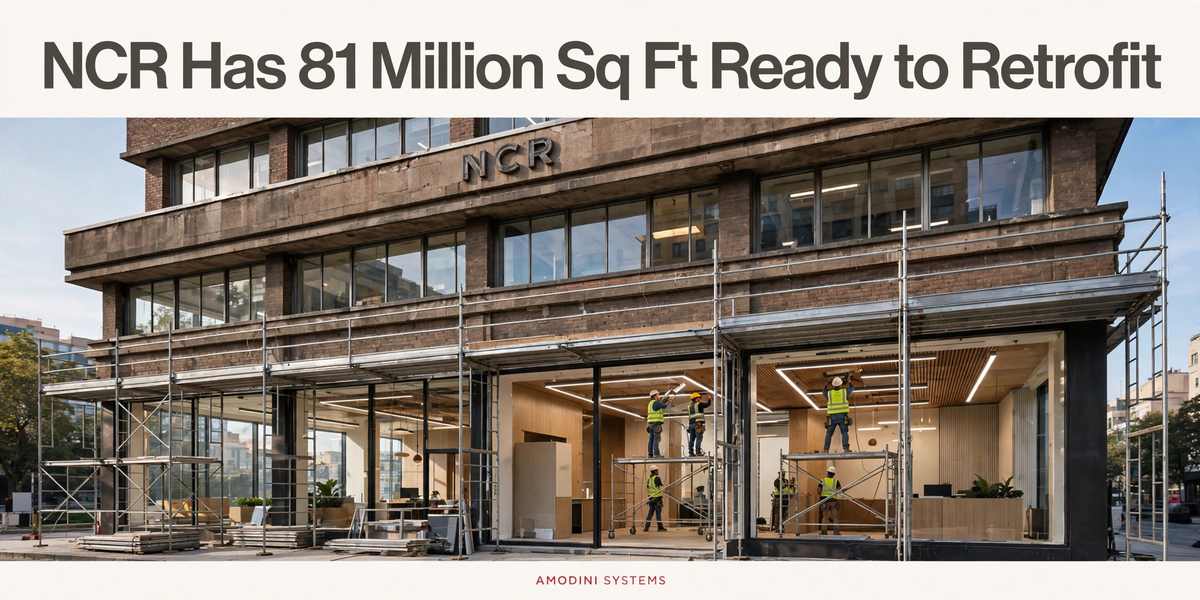
NCR has the largest retrofit opportunity by volume. Knight Frank puts 81 million sq ft of NCR stock in the retrofit bracket, 39 per cent of the region’s total stock. Its value could rise 82 per cent, from Rs 1.31 lakh crore to Rs 2.38 lakh crore. Inside NCR, central business districts hold about Rs 68,900 crore of the gain, across Connaught Place, DLF Cyber City and key Noida corridors, while secondary districts hold about Rs 37,900 crore. Many Noida corridors have the location and workforce, but not an interior that matches how teams work now, which is where our office interior designers in Noida come in.
Read the big figure the right way
The Rs 3.76 lakh crore national figure needs careful reading. It is the potential rise in asset value if eligible buildings are upgraded and then achieve higher rents. It is not the cost of the work, and it is not guaranteed. Knight Frank’s own note says the uplift rests on higher achievable rents and lower capitalisation rates for upgraded buildings. A building with new systems but a poor layout and weak acoustics will not command the same rent.
What retrofitting actually covers
Retrofitting means upgrading an existing building with modern systems, technologies and materials, without full redevelopment. The report covers mechanical, electrical and plumbing systems, facades, lifts, lobbies, parking, fire and life safety, digital infrastructure and security. Shishir Baijal of Knight Frank says occupier expectations are shifting towards more efficient, sustainable and technology enabled workplaces. The interior side is where our office interior designers in Delhi spend most of their time: new layouts, meeting rooms that hold sound, and lighting that suits screen work.
Retrofit or move: four checks first
Before committing either way, four checks help. First, check the building systems. Lifts, air conditioning, power backup and fire safety decide how much budget goes to the base building and how much is left for the interior. Second, check the floor layout. Column spacing, ceiling height and light decide how many meeting and call rooms the floor can hold. Third, check whether work can be phased floor by floor. Fourth, compare the full cost of staying with moving, including rent during the gap, fit-out in the new building and downtime. A turnkey office interior planned as one job makes that comparison honest, because the price covers the whole job.
An old building in a good location should not be written off, and it should not be kept as it is either. The decision is practical: does this building, after upgrading, give your team a better working day than a move would? Answer that with a site visit and a costed plan, not with a headline figure.
Sources: Economic Times, 17 November 2026; Business Standard, 17 November 2026; ET HRWorld, 17 November 2026.