Office Renovation vs New Office Fit-Out: Cost, Time and How to Decide (2026-27)
Your lease is coming up, or the floor has stopped fitting the team, and two options are on the table: spend money on the office you have, or take another floor and build it out. Most people line up two construction quotes and pick the smaller one. That comparison leaves out deposits, double rent, moving, strip-out and the weeks a live office loses to dust and noise.
The short version. Renovating usually costs less to build, but it often takes longer to finish than owners expect, because work on an occupied floor has to be done in zones. A new fit-out costs more per sq ft and moves faster on an empty floor, yet the true bill carries a lot that never shows up in the contractor's quote. Pick the route that removes the actual problem with your office. The sections below show how to test that with numbers.
What the two routes mean
A new office fit-out turns an empty or newly leased floor into a working office: partitions, electrical, air conditioning, ceilings, flooring, furniture and IT. A renovation changes an office your team already uses. Flooring, lighting, ceilings, workstations, meeting rooms and sometimes the AC and wiring get replaced or moved while the walls and the lease stay put.
The words overlap in practice. Contractors and landlords use "refurbishment" and "renovation" for the same job. A rough split helps: refurbishment is surface work such as paint, carpet and chairs, while renovation reaches into layout and building services. A light renovation might be a repaint, new lights and fresh desks. A heavy one moves walls, upgrades AC and rewires a floor, and can cost close to a modest fit-out. Whatever label a quote carries, ask for the scope written out line by line.
Start with the floor you would be working on
The starting condition changes the budget more than the route does. There are four common cases.
- Bare shell. Concrete, columns and basic services only. You get the most freedom and the most work. One JLL breakdown for Asia Pacific puts building works at about 38 percent of a typical fit-out budget and mechanical and electrical at about 25 percent, so 63 percent of the spend sits in work a finished floor has already done. Delhi NCR landlords rarely pay toward it, though some offer a rent-free period while you build.
- Warm shell. Part of the services and finishes are already in. What counts as "warm" differs from building to building, so ask for the handover list before comparing rents.
- Second-generation space. A floor a previous tenant fitted out. Usable AC, flooring or partitions can cut your cost, but their condition is unknown until someone checks.
- Fitted or managed office. Furnished and ready. Upfront spend is low, and the landlord recovers it through higher rent, a separate fit-out charge or a longer lock-in. If your headcount is uncertain, price a managed office as a third option next to the other two.
A bare shell at a lower rent can cost more overall once the fit-out is added. Rent alone tells you very little.
Side by side
| Factor | Renovate the current office | Fit out a new space |
|---|---|---|
| Build cost per sq ft | Usually lower when services and finishes can stay | Usually higher, since more has to be built |
| Total bill | Build cost, strip-out, phasing premium | Build cost plus deposit, overlapping rent, moving, IT migration, reinstatement of the old floor |
| Time to finish | Short for light work, longer for heavy work done in zones | Faster on an empty floor, but design, approvals and procurement run first |
| Disruption | Your team sits through it | Low during the build, concentrated in the move |
| Layout freedom | Limited by columns, services and ceiling height | Wide, within the new building's limits |
| Surprise risk | Higher: old wiring, damp and weak slabs show up after opening walls | Lower on a bare shell, still present on a second-generation floor |
| Room to grow | Capped by the floor you have | Can be planned in from the start |
| Paperwork | Landlord permission, building rules, fire changes | Landlord NOC, fire NOC, occupancy certificate, new lease |
Why renovation often takes longer than a new fit-out
This surprises people, so it deserves a plain explanation. A small renovation, such as new lights, paint and a few desks, is quicker than any fit-out. Compare like for like, though: a heavy change to a floor your staff still use, against the same change on an empty floor. The renovation loses on time, for these reasons:
- Work goes zone by zone. The contractor mobilises more than once, and furniture is shifted between zones.
- Noisy and dusty jobs move to evenings and weekends, which shortens the productive hours on site.
- A floor with an old fit-out needs strip-out first, usually one to two weeks.
- Opening a ceiling or a wall often reveals problems that grow the scope halfway through.
- Many NCR commercial buildings restrict working hours and material movement, which slows deliveries.
Published guides put the stretch from phasing at somewhere between 30 and 70 percent. As an illustration, a scope that takes 40 days on an empty floor would run about 52 to 68 days in zones.
Ranges from Indian contractors' published timelines for a new fit-out on an empty floor, measured from design to handover:
| Floor size | New fit-out, empty floor |
|---|---|
| Up to 2,000 sq ft | 6 to 10 weeks |
| 2,000 to 5,000 sq ft | 9 to 14 weeks |
| 5,000 to 10,000 sq ft | 10 to 16 weeks |
| Large, complex or premium | 12 to 20 weeks or more |
| Renovation, light scope (finishes, furniture, lighting) | Roughly 2 to 8 weeks |
| Renovation, heavy scope on an occupied floor | The fit-out time for the same scope, plus 30 to 70 percent |
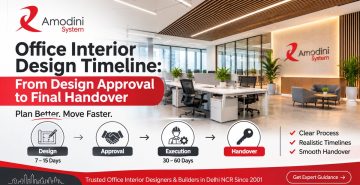
At Amodini the work runs in nine steps, with design taking 7 to 15 days and execution 30 to 60 days. On an occupied floor, expect the execution stage to stretch because the work is split into zones.
A new fit-out is really four clocks running together: design, approvals, procurement and execution. The slowest one sets your date, not the speed of the labour crew. Landlord and fire approvals can add two to four weeks in a business park or mall.
One more distinction. Planning the physical move takes about 8 to 12 weeks. The whole relocation programme, covering the property search, lease talks and fit-out, usually takes 6 to 12 months. The quick build on a new floor is a small part of a longer timeline.
The carpet-area trap
Before comparing any two prices, check what area they are charged on. Leases are usually priced on super built-up area. Carpet area, the part you can actually design and furnish, is typically 65 to 75 percent of it.
Take a lease of 4,000 sq ft super built-up. Your usable carpet area is roughly 2,600 to 3,000 sq ft. A quote at Rs 2,500 per sq ft on carpet area and a quote at Rs 2,500 on super built-up area differ by hundreds of thousands of rupees for the same floor. Always ask which area a quote uses, and whether GST is added on top.
What things cost in Delhi NCR
Amodini prices work at three levels: Rs 1,700, Rs 2,500 and Rs 3,500 per sq ft, without GST, with 18% GST extra. Where your floor lands depends on how much of the existing flooring, ceiling, electrical work and furniture survives the site survey. Prices may change. Always ask for the current price.
The table below shows the arithmetic on carpet area, with a 10 percent buffer for changes and 18 percent GST. It is not a quote, and it shows why the number on the first page is rarely the number you pay.
| Carpet area | Rate per sq ft | Base cost | With 10% buffer | With 18% GST |
|---|---|---|---|---|
| 3,000 sq ft | Rs 1,700 | Rs 51.0 lakh | Rs 56.1 lakh | Rs 66.2 lakh |
| 3,000 sq ft | Rs 2,500 | Rs 75.0 lakh | Rs 82.5 lakh | Rs 97.4 lakh |
| 3,000 sq ft | Rs 3,500 | Rs 105.0 lakh | Rs 115.5 lakh | Rs 136.3 lakh |
| 5,000 sq ft | Rs 1,700 | Rs 85.0 lakh | Rs 93.5 lakh | Rs 110.3 lakh |
| 5,000 sq ft | Rs 2,500 | Rs 125.0 lakh | Rs 137.5 lakh | Rs 162.3 lakh |
| 5,000 sq ft | Rs 3,500 | Rs 175.0 lakh | Rs 192.5 lakh | Rs 227.2 lakh |
The last column runs about 30 percent above the base. Ask every contractor what the rate covers. Furniture, air conditioning, IT cabling and fire safety work are inside some quotes and outside others. For a deeper look at rates in the capital, see our guide to the cost of office interior design in New Delhi, and for fee structures, read how much interior designers charge in India.
Where each route spends money
| Cost line | Renovation | New space |
|---|---|---|
| Construction | Yes, on what changes | Yes, on the full floor |
| Strip-out and debris | Yes | Only if the floor has an old fit-out |
| Furniture | Reduced if you reuse | Usually new |
| Electrical and AC upgrades | Often, if capacity falls short | Planned in at design stage |
| Security deposit | None new | Commonly 6 to 10 months of rent |
| Rent on two floors | None | During the build and the move |
| Moving and IT migration | Small, between zones | Full move |
| Reinstating the old floor | None | Possible, depending on the lease |
| Maintenance charges | Unchanged | Can add 15 to 30 percent to base rent in some Grade A buildings |
| Phasing premium | Yes, for work around a live floor | No |
| Approvals | Landlord permission, fire changes | Landlord NOC, fire NOC, occupancy certificate |
| GST and buffer | Yes | Yes |
Compare both routes on one cost model
A fair comparison puts both options on one sheet. A method that works:
- Pick one time horizon for both, such as the remaining lease or five years, with the same tax treatment on every line.
- Split the money into three groups: cash needed up front, cost while you occupy the space, and cost when you leave.
- Show deposits separately. They come back eventually, but they tie up cash on day one.
- Price the disruption. Add temporary seating, out-of-hours labour, overlapping rent and the staff time spent coordinating. Name the specific activities that would stop, instead of guessing a productivity loss for everyone.
- Ignore sunk cost. What you spent on the current fit-out five years ago does not matter. Existing furniture and partitions count only if keeping them avoids a future spend or they have a real resale value.
- Count landlord contributions carefully. Note what they cover, when the money arrives and whether you must pay first. Some landlords offer a fit-out contribution when you sign a longer renewal, and a renewal quote is a starting position. We did not find a Delhi NCR figure for this, so ask for one and do not assume it.
Then run a payback check. If moving costs more up front, divide that extra cost by the yearly net saving it brings. Suppose the move costs Rs 45 lakh more in total and cuts rent by Rs 9 lakh a year. Payback is five years. On a lease of three years, that move loses. On a nine-year lease it may pay. These numbers are made up to show the sum; use your own.
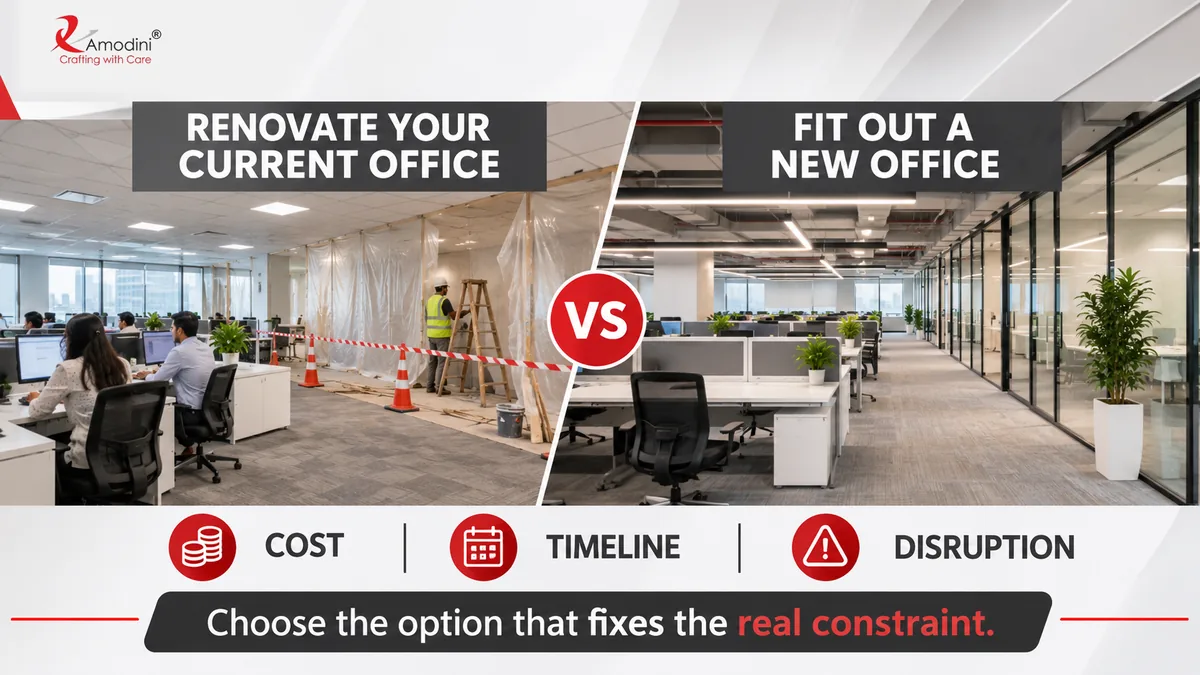
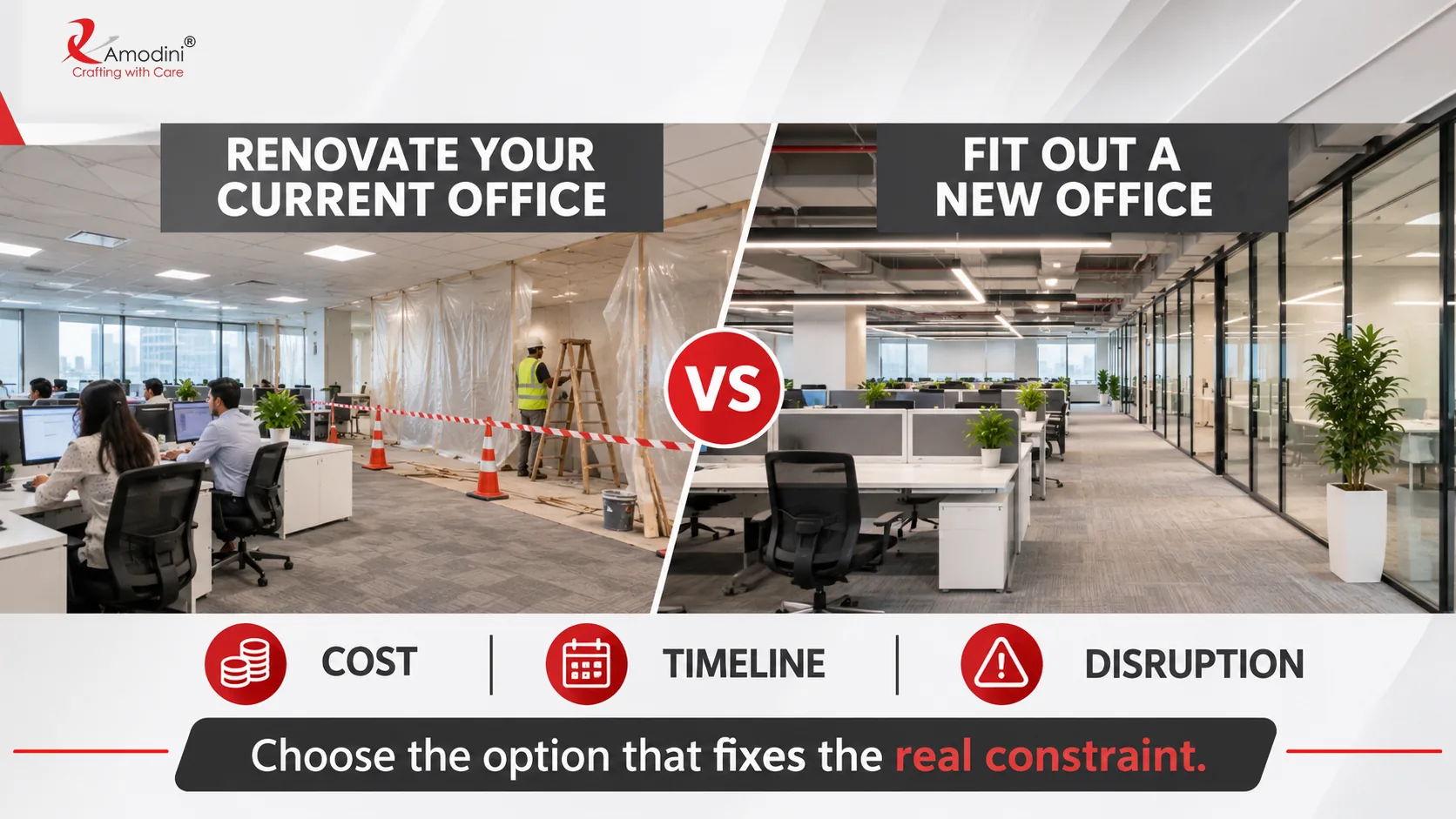
The decision rule that follows: choose the option that fixes the underlying constraint. If your location works and the building's services can carry the plan, renovation wins. If another floor meets the brief better and the saving covers the move, fit-out, and exit costs, moving wins. Lower rent by itself is not enough.
Strip-out: the line quotes tend to bury
Strip-out means removing what is already there: old partitions, ceilings, flooring, cabling and fixtures, and carrying the debris off site. It sits inside "civil work" in many quotes and gets missed. Ask for it as its own line. On a floor with an older fit-out it typically adds one to two weeks, and it applies to a new space too if the previous tenant left a fit-out behind. Our note on civil work in office interiors explains what this covers.
Since 1 April 2026, India's Construction and Demolition Waste Management Rules reach renovation as well as new construction. The registration and waste-plan duties apply to projects of 20,000 sq m built-up area and above, which is far larger than most office floors, but your contractor should still tell you how debris leaves the site and where it goes. If your project is large, take legal advice, since the rules are new.
What to keep, what to repair, what to replace
Run an audit before any quote, floor by floor and item by item.
- Keep: flooring in good shape, AC that still performs, partitions that fit the new plan, structured cabling that tests clean.
- Repair or reconfigure: workstation frames, storage, doors, chairs that need new foam or fabric.
- Replace: worn carpet, failing electrical, leaking or undersized AC, anything unsafe.
Furniture often makes up a third or more of an office budget, so reuse moves the renovation sums more than any other choice. Because Amodini makes its own furniture, we can look at existing workstations and chairs, repair or reconfigure them in our own setup and price that reuse honestly. For more ways to stretch spend, see our guide to designing an office on a tight budget.
Weigh remaining life too. Keeping an unreliable AC plant only moves its replacement cost into the first years of your next lease.
Electrical, AC and fire safety: the checks that can end a renovation
A renovation looks cheap until a building system says no. Check these before you commit.
| Check | Why it matters |
|---|---|
| Electrical load | More seats and more AC need more power. Load enhancement needs approval and lead time. |
| AC capacity | Moving partitions changes airflow. An old plant may already be at its limit. |
| Ceiling height | New ceilings, ducts and lights need clearance. |
| Floor loading | Server rooms, storage and heavy equipment need slabs that can take them. |
| Fire safety | Sprinklers and detectors must move with a new ceiling and cabin layout, and changes need approval. |
| Landlord permission | Changes, working hours, material movement and a work deposit are set by the building. |
One failed check may cost enough to erase the renovation saving. Several failures point to a new space. Turning an open area into several meeting rooms, for example, changes ventilation, cooling, lighting, power, fire protection and cabling together, and a partition budget alone will not cover it.
Can your team keep working while the work happens
Usually yes, with a plan written before the design is finished. Three documents should exist before the first day on site: a phased construction schedule, a site logistics plan and a communication note for staff.
A simple phasing plan for a small floor:
- Move half the team into the other half, using temporary desks.
- Finish the empty half.
- Move the team across over a weekend.
- Finish the second half, then rebalance the desks.
A few rules keep it workable. Drilling, cutting and demolition go outside office hours, before 7 am, after 6 pm or on weekends. Leave two to three working days between phases for snagging, cleaning and people returning. Cable pulls and network changes happen off-hours too, because IT is where disruption bites hardest. Ask the contractor to price phased working against a full move-out so you see the trade in rupees. Check the building's rules on night work and material movement in writing before fixing dates.
A new fit-out on an empty floor has almost no disruption during the build. Its disruption comes at the move, so plan the date, label every item to match the new seating plan, and test IT 48 to 72 hours before staff arrive.
We work across Delhi, Noida and Ghaziabad. If you are weighing floors in the capital, our office interior designers in Delhi can survey both your current floor and the new one.
Lease timing often decides it before cost does
The lease usually settles the question before any quote is read.
- More than three years left and no break clause: renovate by default.
- A break clause or expiry within 18 months: moving becomes a real option. Begin the assessment about 18 months before that date, since a proper review takes several weeks.
- Renewal on the table: treat the first rent offer as an opening position. A credible alternative floor can bring it down.
- Headcount uncertain: renew for two or three years instead of five, with options to expand.
- Floor already tight: do not renew into it. A renovation only buys two years before the next move.
Read the lock-in, the notice period, the restoration clause and the deposit refund terms first. A clause that requires returning the floor to bare shell can cost more than people expect.
A six-point checklist for your office
Mark each row for your situation.
| Factor | Leans to renovation | Leans to a new space |
|---|---|---|
| Lease | 3+ years left, no break clause | Break or expiry within 18 months |
| Headcount | Stable, or growth the floor can hold | Growth the floor cannot hold even with denser seating |
| Building services | Power, AC and fire systems can carry the plan | Major replacement needed, or the load cannot be met |
| Location | Still works for staff and clients | Hurting hiring, commute or client access |
| Budget and cash | Cannot fund a deposit plus overlapping rent | Can fund the move, and the saving pays back |
| Disruption tolerance | Team can sit in zones and accept out-of-hours work | Cannot live with works on the floor |
Count the rows. Four or more in one column is a clear lean. A split result points to a third path: use the alternative floor as leverage to negotiate the renewal, then renovate what the survey shows needs fixing.
When staying put is the right call
Staying makes sense when the location still works, the floor can hold your headcount for the next few years, and the problems are layout, finishes and furniture rather than power or AC capacity. Our guide to the office renovation process covers the steps for that route.
When a new space is the right call
Moving makes sense when the floor cannot take more people, building systems need heavy replacement, the lease ends soon, or the location is costing you hires and clients. It also suits companies that need a very different layout from the one the columns allow.
Mistakes that make the wrong choice expensive
- Comparing quotes on different area bases, carpet against super built-up.
- Pricing the build only and forgetting deposit, overlap rent, moving and reinstatement.
- Skipping the site survey, then finding weak wiring or damp after the walls open.
- Letting past spend on the current fit-out sway the decision.
- Renewing for five years on a floor that is already full.
- Leaving out a buffer. We use 10 percent in our sums.
- Ignoring building rules on working hours and material movement until the schedule is already set.
- Judging by rent alone.
If you move: the paperwork that follows
Confirm the new floor has an occupancy certificate before you sign. Fire clearance usually comes in two stages, provisional at plan approval and final after inspection. After the move, a registered address change needs a GST amendment (Form GST REG-14) within 15 days if you stay in the same state, and the company's registered office update (Form INC-22) within 30 days after a board resolution. Bank accounts, PF, ESIC, professional tax, Udyam registration, invoices and your Google Business Profile need the new address too. Check dates with your chartered accountant.
How Amodini plans both routes
We have worked for more than 20 years, across 5,000+ projects, and hold a 4.4 star rating from 74 reviews. Both routes follow our nine-step process, with the survey and approvals steps differing between them. Ask any contractor, ourselves included, for a BOQ that shows strip-out, electrical, AC, furniture and the buffer as separate lines, so the two routes can be compared on one sheet. Our turnkey office interiors service keeps design, civil, electrical and furniture under one contract, which helps most on an occupied floor where several trades work around your team. If your office is in Ghaziabad, our office interior designer in Ghaziabad page lists how we work there.
Book a site visit, and we will price both routes on the same sheet. Prices may change. Always ask for the current price.
Frequently asked questions
What is the difference between office renovation and office fit-out?
A fit-out builds out an empty or newly leased floor. A renovation changes an office you already occupy. Many projects mix both, so agree the scope in writing.
Is office renovation cheaper than a new fit-out?
It usually costs less to build, since services and finishes can stay. A heavy renovation with strip-out, electrical upgrades and phasing can approach the cost of a modest fit-out, and a move adds deposit, overlap rent and reinstatement that renovation avoids.
How long does an office renovation take?
Light work takes a few weeks. Heavy work on an occupied floor takes the fit-out time for the same scope plus roughly 30 to 70 percent, because it is done in zones.
Can an office be renovated without shutting down?
Often yes. Work is split into zones, noisy jobs move to evenings and weekends, and the team shifts between halves of the floor. It costs more and takes longer than an empty-floor build.
Do I need permission to renovate or fit out an office?
Generally you need your landlord's consent and the building's rules on working hours. Fire changes need approval, and a new space needs an occupancy certificate and fire clearance. Confirm the details for your building.
What is the difference between renovation and refurbishment?
Refurbishment leans toward surface work such as paint, carpet and furniture. Renovation reaches into layout, AC, electrical and cabling. Contractors use the words loosely, so check the scope.
What is the difference between bare shell and warm shell?
A bare shell has basic structure and services only. A warm shell has some services and finishes in place. The exact scope varies by building, so ask for the handover list.
Can I renovate part of the floor and move other teams out?
Yes. A split plan works when one department needs space the floor cannot give and the rest fits. Price it as a third option on the same cost sheet.
What does an office fit-out cost per sq ft in Delhi NCR?
Amodini works at Rs 1,700, Rs 2,500 and Rs 3,500 per sq ft without GST, with 18 percent GST extra. Prices may change. Always ask for the current price.