
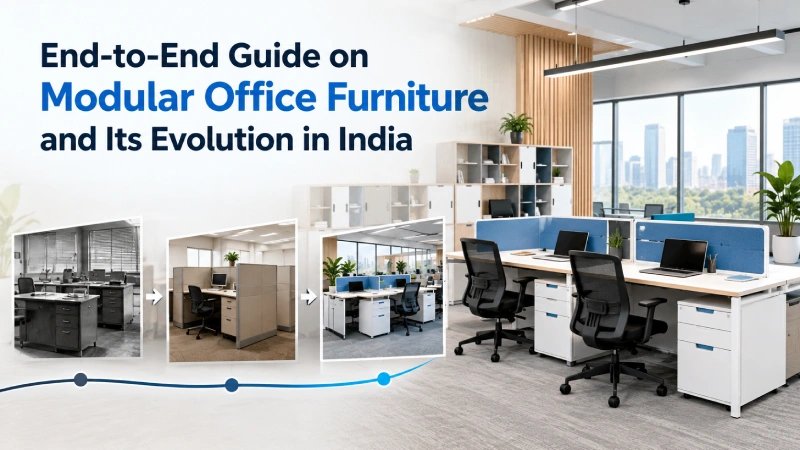
End-to-End Guide on Modular Office Furniture and Its Evolution in India
ByAmodini
November 13, 2026
Modular Office Furniture in India: A Complete Guide for 2026-2027
In the rapidly growing world of Indian startups and expanding companies, modular office furniture is the most practical way to build a workspace that grows with the team. The Indian office furniture market is expanding fast Modular furniture is already the standard choice in startups and large firms alike, because it prevents the problem of owning bulky furniture that cannot be expanded or rearranged as the team grows. Offices are no longer fixed layouts. A team of 10 can become a team of 30 in a year, and the furniture should keep up. Modular systems let a company add desks, move partitions, and reshape a floor without buying everything again. This guide covers what modular office furniture is, its types, its key traits, how it improves work performance, and how to plan it for real offices in 2026 and 2027. If you are planning a new office, our office interior design company plans the furniture together with the full fit-out.What Is Modular Office Furniture?
Modular furniture for the office is furniture built in independent units that can be dismantled and combined as needed. A workstation, a storage unit, a partition, or a conference table is made of standard modules. The workplace can combine and expand these pieces, adapting to the growing needs of the organisation. When a company chooses turnkey office interiors for a new office, modular furniture is usually the best fit, because the design, the furniture, and the execution come from one team and stay consistent. Modern offices are built for change, not like traditional offices with fixed furniture and once-and-done interiors. Modular setups let employees feel less boxed in, which helps productivity and creativity.Different Types of Modular Office Furniture
Modular furniture is not limited to desks. It covers every corner of the office, from collaborative spaces to individual desks to document storage. Each type serves a specific purpose, and together they form the blocks that build a working ecosystem.1. Modular Workstations
Modular workstations are flexible and suit different working styles and team sizes. They store and arrange cables, let teams relocate elements, and create private spaces where needed. They follow ergonomic principles, with adjustable height options that reduce strain and support better working performance. Compactly connected workstations also save a lot of aisle space, and they can be moved to another part of the floor and laid out as a small island when the team changes.2. Modular Storage Units
Modular storage covers cabinets, closets, drawers, partitions, and shelves. Units can be stacked or arranged in different configurations to suit the space. Locking systems protect important documents. Because storage is modular, a company can add a cabinet when the team grows instead of replacing a whole storage wall.3. Modular Conference Tables
Modular conference tables can be joined into one large boardroom table or split into clusters of smaller tables. They have built-in technology such as USB ports and cable routing, which keeps meetings tidy and makes a good impression on visitors. For a growing company, one set of tables can serve a 4-person huddle today and a 14-person review tomorrow.4. Modular Seating Solutions
Seating ranges from comfortable desk chairs to adaptable lounge sofas and sectional benches. Adjustable lumbar support and breathable materials keep people comfortable and healthy during long working hours. Modular seating can be rearranged for different group sizes, so the same pieces serve a training session, a client wait, and a team break.Key Traits: Scalability, Flexibility, and Customisation
1. Ease of Installation
Unlike ordinary furniture, which needs drilling or professionals to build, modular systems are easy to install and dismantle because they use durable connections. They do not break during frequent moves, which matters for companies in rented offices. Modular workstations can also be disassembled easily when the office relocates, so there are no carrying problems.2. Seamless Scalability
Modular furniture expands with company growth. Adding desks, partitions, or cabinets does not mean throwing away what is already used. This saves money and reduces waste. A company can start with what it needs today and add modules as headcount grows.3. Ultimate Flexibility
Modular systems can be rearranged whenever needed. A company can try different configurations instead of staying locked into one layout. An open area can become quiet focus booths for a project sprint, then turn back into a collaborative pod the next week. This is especially useful in hybrid work, where occupancy changes through the week.4. Customisation
Every business is unique, and modular components can be assembled to match. A company can choose a colourful layout that supports collaboration, or a calmer layout that supports concentration. The same modules serve both, because the design is in the arrangement, not in fixed pieces.How Modular Furniture Improves Work Performance
Cookie-cutter offices look dull and hurt productivity. A tailored modular workstation changes how the space feels and how people work in it.- Comfort and ergonomics. Adjustable desks and supportive chairs reduce strain, so people stay focused longer and take fewer breaks for discomfort.
- Focus where it is needed. When employees can choose a quiet zone for deep work and an open area for discussion, they stay engaged and efficient.
- Creativity. Being glued to the same place for too long means getting stuck with the same ideas. Rearranging furniture changes sightlines and movement, which helps teams think differently.
- Retention. People value a workplace that adapts to their needs. Comfortable, functional furniture is one of the reasons employees stay.
- Agility. When a new team forms, extra seating and desks can be added in a day. The office never blocks the business.
Space Gains: Tips for Planning a Modular Layout
Before selecting any modular units, evaluate current needs and future needs together. Count the people, the equipment, and the way teams actually work. Then plan for growth, because a layout that only fits today will feel cramped in six months.- Think outside the box. Do not commit to one shape. Choose individual components. Want a wider desk? Add a module instead of buying a large, bulky table.
- Think multi-functional. Every corner should work. A desk and a storage unit can become a practical workstation in no time, and a partition can double as display or storage.
- Think flexible. Build workstation islands with detachable units that boost productivity and cut clutter. Shared printers and peripherals can serve several workplaces, which saves space.
- Plan the flow. Keep aisles clear and keep the most-used shared items within easy reach of every team. Compactly connected workstations save aisle space and keep the floor open.


[…] suppliers now offer refurbished or remanufactured options as part of a circular approach. Read our modular office furniture guide to plan it […]
[…] a mobile storage unit give you a full office at a fraction of the cost of fixed furniture. Read our modular office furniture guide for the full […]
[…] can set a lighting and temperature profile through an app, and the desk remembers it. Read our modular office furniture guide for desks that work with smart […]
[…] people sit in different places every day and cannot adjust a fixed setup to suit them. Read our modular office furniture guide for the pieces that work […]
[…] as teams change, and it suits the mix of open floors and cabins that Delhi offices use. Read our modular office furniture guide for the pieces that work […]
[…] Modular desks, moveable partitions, and stackable seating let the office change as the team changes. A floor that can be rearranged in an afternoon is worth more than a fixed layout that fits only today. Read our modular office furniture guide. […]
[…] furniture, we compare modular office furniture and custom furniture on the same points: size flexibility, material and finish options, cost, […]